Balaam and the Talking Donkey
Crazy Mama: 9 Steps to a Not-So-Normal LifeBalaam and the Talking Donkey is a biblical episode Hannah Keeley uses to show how compromise can make a person blind to the very danger that an apparently lesser creature can see. Balaam sets out toward Moab after being tempted by Balak’s promised honor, although God has forbidden him to curse the Israelites. On the road, his donkey repeatedly resists the journey because the Angel of the Lord is blocking the way. Balaam answers each warning with violence; the donkey’s eventual speech reverses their apparent roles, and the Angel reveals that her disobedience to her master has in fact protected his life.
The Request and the Compromise
Balak, king of Moab, fears the Israelites, who have arrived near his territory after overtaking kingdoms, claiming land, and growing in number. He believes Balaam’s blessing or curse can determine the outcome, so he sends for the prophet and asks him to curse the Israelites, whom he regards as too powerful for Moab. Balak’s first delegation arrives with gifts and inducements. Balaam does not answer immediately; he asks the visitors to stay overnight while he consults God.
That night, God tells Balaam not to go with the men and not to curse the Israelites, because they are blessed. Balaam sends the delegation away the next morning. The refusal should settle the matter, but Balak tries again, this time sending more numerous and more distinguished princes and promising Balaam great honor. Balaam says that even a house filled with silver and gold could not authorize him to go beyond God’s word. Yet he again allows the visitors to stay overnight and consults God anew. In Keeley’s telling, the temptation is not simply the offer itself: continued proximity to the promised riches gives Balaam more time to imagine what compromise might gain him.
God permits Balaam to go if the princes come to call, but commands him not to do anything beyond what God says. They do not call on him that night. Balaam nevertheless rises, saddles his donkey, and goes with the Moabite men without permission. The narrative presents this departure as a consequential breach: Balaam knows the instruction, but his attraction to the promised rewards has begun to displace it.
Three Encounters on the Road
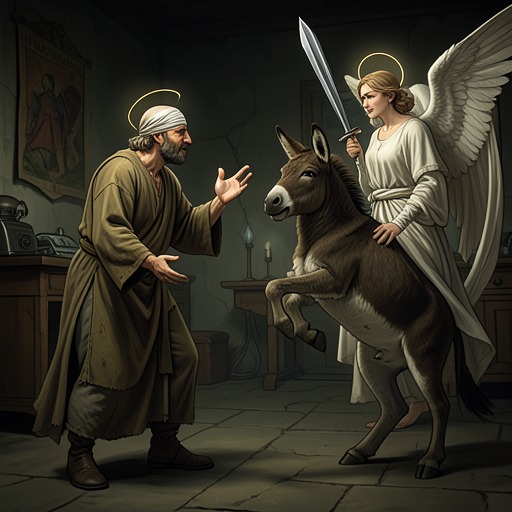
God’s anger is kindled as Balaam travels, and the Angel of the Lord stands in the road as an adversary. The donkey sees the Angel, whose sword is drawn, and turns away from the path into a field. Balaam, unable to see what she sees, strikes her to force her back onto the road. The first interruption therefore sets the pattern for the whole episode: the animal responds to an unseen threat, while the prophet interprets her resistance as a problem to punish.
The Angel next stands in a vineyard path, with a wall on either side. The donkey again sees the obstruction and presses against one wall, crushing Balaam’s foot. Balaam strikes her a second time. The narrow passage makes the cost of his journey physical: the donkey cannot simply move past the Angel, and her attempt to avoid danger injures the rider she is carrying. Keeley connects the constricted route with the pressure involved in choosing the way that leads to life, while emphasizing that the pain of a difficult process does not make the warning itself wrong.
At the third encounter, the Angel stands in a place so narrow that there is no room to turn either right or left. Seeing no way through, the donkey falls beneath Balaam. He responds by striking her with his staff. The sequence escalates from a turn into a field, to a crushed foot between walls, to a collapse in an impassable space; Balaam’s growing anger does not improve his sight or open the road. In Keeley’s interpretation, the animal’s three acts of resistance are protective, even though Balaam experiences them as obstruction and answers them as insubordination.
The Donkey Speaks and the Danger Is Named
After the third beating, God opens the donkey’s mouth. She asks Balaam what she has done to deserve being struck three times. Her speech interrupts the physical pattern that has governed the scene: Balaam has been able to hit her, but not to understand her. The question makes him answer her, and the exchange creates a pause in which the true conflict can be disclosed.
The Angel then asks why Balaam has struck the donkey and explains that the Angel came to oppose him because his conduct was willfully obstinate. The donkey had seen the Angel and turned aside three times. The Angel adds that if she had not done so, Balaam would have been killed while she was spared. The revelation reverses the apparent balance of judgment: Balaam had treated the donkey as a foolish animal blocking his plans, but she had repeatedly perceived the danger and acted to save him. Her punishment had fallen on the one who was responding faithfully to what she could see.
Meaning and Narrative Function
Keeley uses the episode as a warning about the progression from knowing a boundary to entertaining an exception. Balaam’s first response to God is clear, but Balak’s second offer keeps the possibility of reward in front of him. By the time Balaam travels, the book portrays him as focused on the goods he might gain rather than on God’s direction. The donkey’s repeated turns make that spiritual blindness visible as a sequence of concrete roadblocks, each harder to ignore than the last.
The episode also gives obedience an unexpected voice. The donkey is not presented as flawless or powerful by human standards; her importance lies in seeing the Angel and responding, while Balaam’s standing as a prophet does not prevent him from missing what is directly in his path. God’s defense of the animal becomes Keeley’s evidence that divine use and protection are not reserved for the impressive or perfect, but can honor integrity even when it appears in a vulnerable creature dependent on someone else.
The speaking donkey also supplies a structural hinge for Keeley’s later discussion of the power of words. Before the donkey speaks, her turning, pressing against the wall, and falling have not changed Balaam’s course; her question breaks that impasse and leads to the Angel’s explanation. Keeley treats this change as a plot point: speech makes the hidden meaning of the physical actions audible. The episode thus joins the book’s practical lesson about refusing compromise to its broader claim that words can alter what happens, while the donkey’s voice exposes how little Balaam has understood until the road itself can no longer be ignored.